
As artificial intelligence and data-based applications become ubiquitous in industries, companies are looking for computing solutions that not only perform but do so efficiently. Today’s workloads such as AI inference, video processing and real-time analytics need powerful acceleration without adding operational costs. In this landscape, the L4 GPU has proven a highly versatile solution that always offers more than expected for a wide range of use cases.
However, the L4 GPU is optimized for inference, media processing and scalable cloud deployments, not traditional GPUs that are optimized for training or graphics workloads. This makes it a practical choice for organizations that need reliable performance in a varied production environment.
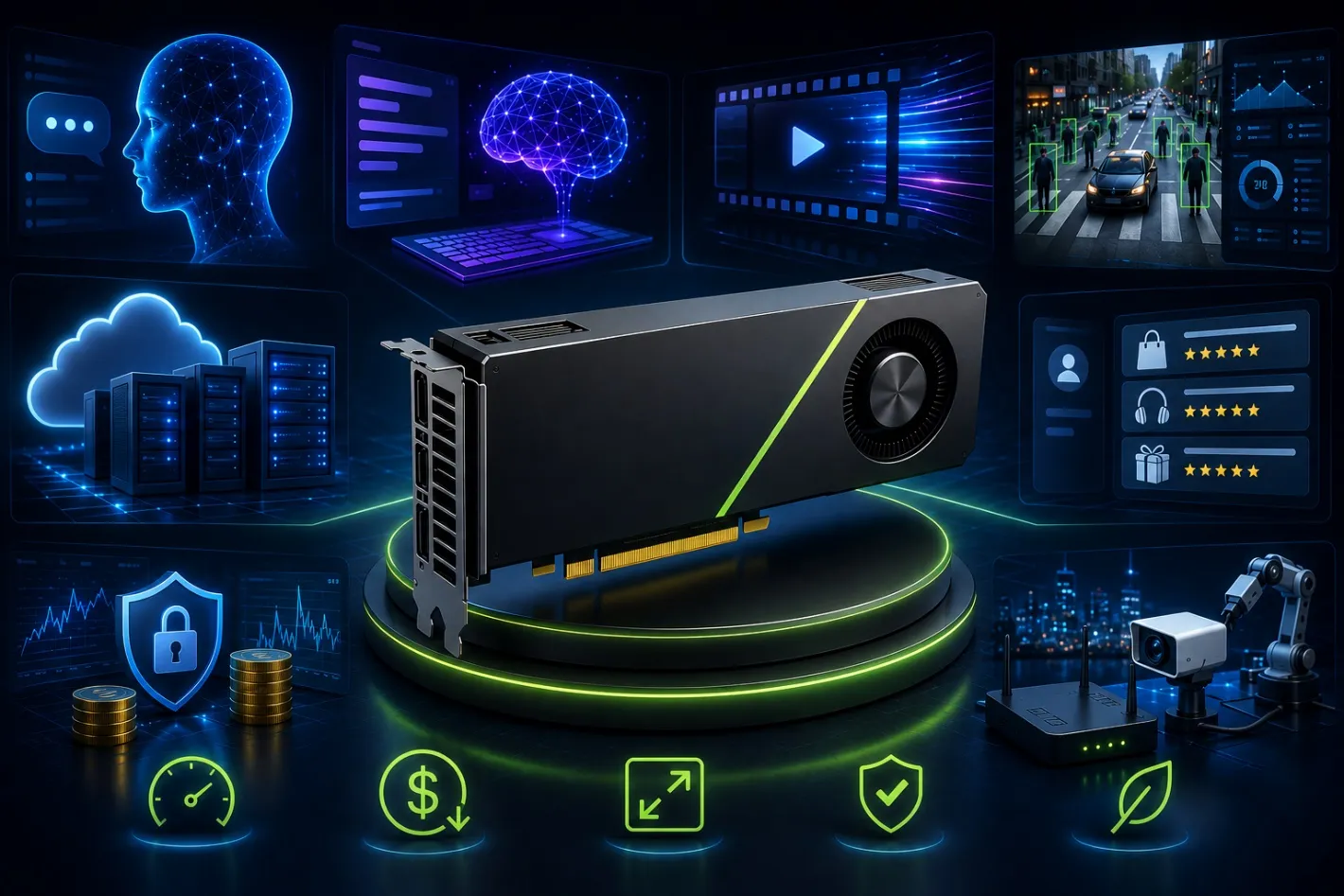
AI Inference at Production Scale
One of the most important L4 GPU use cases is AI inference. After training, machine learning models must be deployed to provide real-time services. Such as chatbots answering questions from users, recommendation engines recommending products, fraud detection systems analyzing transactions, or image recognition tools processing images.
The models will operate effectively on the L4 GPU for achieving low latency and high throughput. Thus, the application is guaranteed to deliver an immediate response even during busy periods.
The reliability of performance is of utmost importance for organizations operating production AI solutions. The L4 GPU is a good fit for large-scale inference deployment, helping to keep response times stable and optimize resource utilization.
Generative AI Applications
Generative AI has been one of the most rapidly growing areas in technology. Real-time inference is required for applications such as AI assistants, content generators, code assistants, and conversational platforms.
The L4 GPU can support large language model inference efficiently, delivering a smooth and responsive AI experience. Be it generating text, summarizing documents, or operating interactive chat systems, the GPU offers fast output under high loads.
That’s why many organizations evaluating infrastructure are also looking at the l4 gpu as a cost-effective option to deploy generative ai solutions at scale.
Real-Time Video Processing
The L4 GPU also does quite well in another big area: video workloads. In the era of video streaming boom, conferencing and content creation platforms, efficient video encoding and decoding becomes inevitable.
The L4 GPU is aimed at accelerating video processing tasks such as compression, transcoding and streaming. That lets platforms deliver high-quality video content with lower latency and more efficiency.
This is important for media companies and streaming services to keep the user experience, while controlling the cost of the infrastructure.
AI-Powered Video Analytics
Increasingly, video data is being used for analytics and automation, not just streaming. Real-time insight is derived from video feeds used in industries including retail, security, transportation and manufacturing.
The L4 GPU processes multiple video streams concurrently with real-time inference models to enable AI-powered video analytics. This includes object detection, face recognition, motion tracking and anomaly detection.
The L4 GPU integrates AI inference and video acceleration in one platform, decreasing infrastructure complexity and allowing faster decision-making in mission-critical applications.
Cloud-Native AI Workloads
Cloud computing has become the default for modern AI application deployment, and the L4 GPU fits naturally into this ecosystem. It lets companies scale workloads up and down on demand, without the expense of buying physical infrastructure.
It’s also good for startups and enterprises with diverse workloads. Cloud-based L4 GPU deployments mean resource utilization is always optimized, whether demand surges at peak times or drops off during off-hours.
This flexibility enables enterprises to manage costs and efficiency associated with infrastructure.
Recommendation Systems and Personalization
Personalization is one of the main engines driving user engagement on contemporary digital platforms. Recommendation engines on e-commerce websites, streaming services and social media platforms are powered by AI.
The L4 GPU allows these recommendation systems to run fast inference, giving users real-time suggestions based on behavior, preferences and historical data.
Because these systems run all day, efficiency and cost-effectiveness are important. This makes the L4 GPU an attractive option for large-scale personalization workloads.
Fraud Detection and Financial Applications
Financial institutions employ AI models for fraud detection, risk assessment and real-time monitoring of suspicious activity. These workloads need high speed inference, and very low latency.
The L4 GPU can process huge volumes of transactional data fast and accurately, making it well suited to these tasks. This will help organizations to minimize the risks of fraud while ensuring operational efficiency.
The L4 GPU is an effective tool for use in financial applications that demand high-speed and high accuracy.
Edge AI and Distributed Computing
The growth of edge computing has resulted in GPUs being deployed in more locations than traditional centralized data centers. The L4 GPU can also be deployed for edge AI workloads that require real-time processing closer to the data sources.
This is especially relevant in smart cities, IoT systems, autonomous systems and industrial automation where latency has to be minimized.
L4 GPU helps AI processing move toward the edge, thus resulting in improved response times and decreased dependence on centralized infrastructure.
Why the L4 GPU Consistently Outperforms Expectations
The L4 GPU is outstanding for its great mix of performance, efficiency, and versatility. It does not restrict itself to one kind of workload and can span many applications in AI, video and cloud computing.
This flexibility enables organizations to consolidate multiple workloads on a single platform, which reduces complexity and increases operational efficiency.
From an infrastructure costs perspective, the L4 GPU can be seen as a long-term investment by companies as it does not sacrifice cost-effectiveness for strong performance.
Final Thoughts
The L4 GPU has become the de facto choice for organizations managing modern AI and video workloads. This GPU is one of the most versatile on the market right now with its ability to handle inference, generative AI, video processing, analytics, and cloud-based applications.
As industries scale to AI, the need for efficient and trustworthy infrastructure will only grow. In this context, the L4 GPU always delivers more than expected and is an attractive option for companies who wish to develop scalable and future-proof systems.