

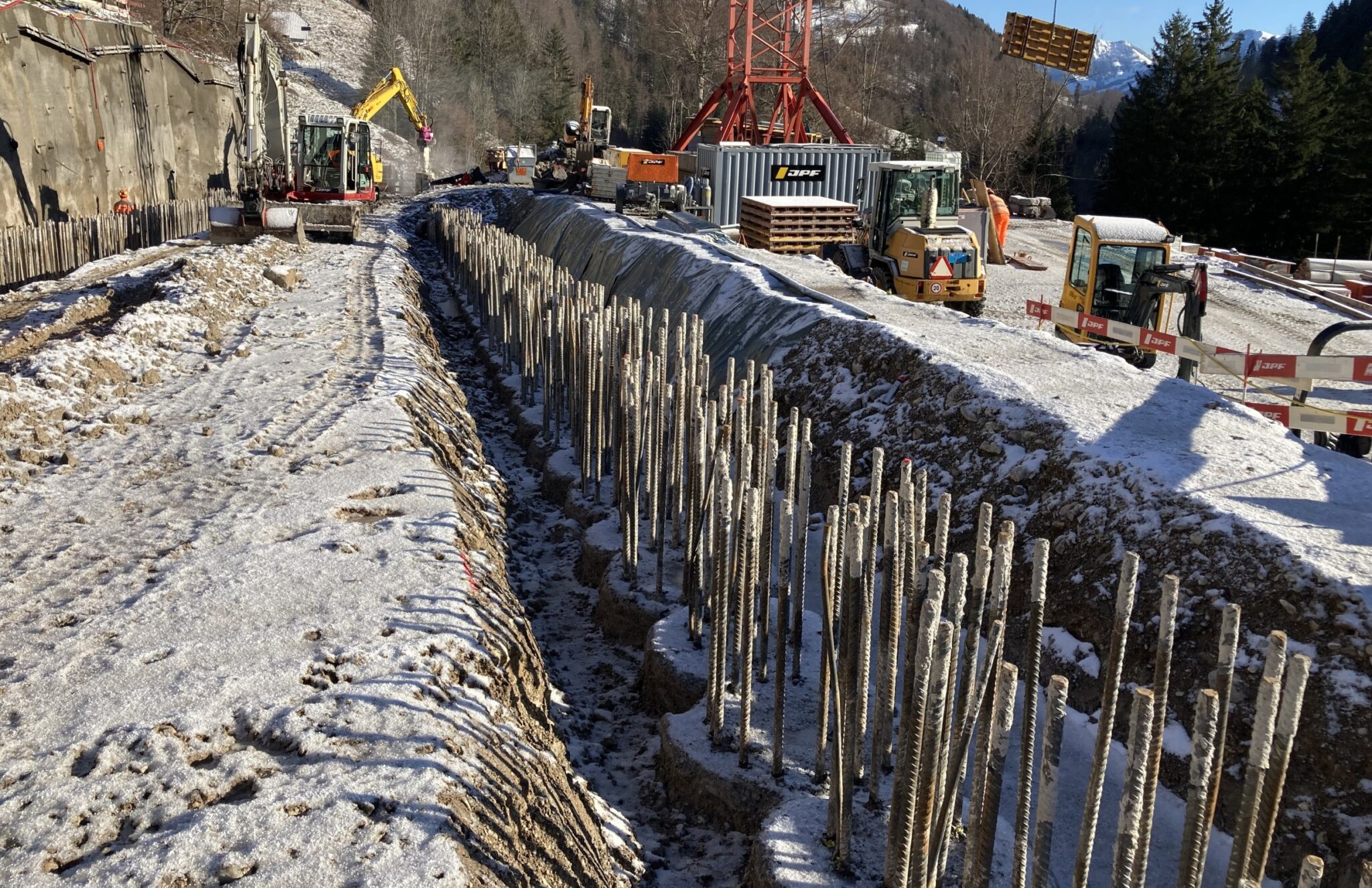
Excavation supports are often needed on construction projects that will have the ability to stabilize the ground, but not take up a lot of space. If engineers require a retaining system that works well, is flexible and can be applied in a variety of soil conditions, they might be interested in considering a tangent pile arrangement. The approach is to drill a series of concrete piles into the ground in proximity to one another, which form a continuous line of support. It is commonly employed in foundation engineering, retaining structures, and other construction projects where stability of the ground is crucial for the success of the project.
Understanding The Basic System
A tangent pile system involves each concrete pile being installed in such a way that they butt against each other, but do not overlap. The piles are bored down to a specific design and then poured with concrete and will receive reinforcement if needed.
Secant pile walls are constructed by connecting adjacent piles, and a tangent pile wall is formed by having stacks of piles in proximity to one another for lateral support. This forms a retaining structure that is able to withstand the pressure of the soil during excavation.
Common Foundation Applications
There are various applications in which the tangent pile system is being used by engineers to construct various construction projects. Common uses include deep basements, commercial buildings, bridge abutments, retaining walls, transportation and industrial use.
The system is especially beneficial when excavation work needs to be done in proximity to existing structures, and it is important to control ground movement. The piles are installed right on the boundary of the excavation, so it is suitable for limited space working.
Advantages For Retaining Walls
The advantages of a tangent pile system are that it can be constructed efficiently. The piles do not overlap, so it does not always have to be as complicated to install these piles as it is with methods that involve cutting through existing concrete.
The arrangement also provides flexibility with the reinforcement and pile sizes according to project requirements. For many retaining wall applications, a tangent pile can be used to provide adequate structural support, decrease the complexity of construction and keep projects on schedule.
Design And Engineering Factors
Careful evaluation of site conditions is needed to ensure the correct use of the right retaining system. Engineers look at many things before they lock in the final design. They check the soil type, underground water, and how deep you need to dig. They also check nearby walls and all expected weight loads for the job.
Crew members use dirt tests and math to set good sizes. This work shows the pile width, post gaps and steel rods to place in the dirt. When installing a retaining wall, alignment must be correct to ensure that the wall will do what it is supposed to during construction and in service.
Construction And Quality Control
Advanced drilling equipment and precise surveying methods are used in modern projects to enhance the quality of installation. If the piles are placed accurately, it will help to form an even retaining wall and minimize alignment issues.
When building tangents, the contractors check the size of the piles, the location of reinforcement and the quality of the concrete to ensure it corresponds to the given engineering requirements. Routine quality assurance helps to ensure safe excavation as well as long-lasting construction.
Conclusion
When you build deep foundations or tall retaining walls, you need a setup that stays strong. You also have to watch tight site limits and get work done fast. That is where a tangent pile layout helps out a lot. These side-by-side piles hold up the dirt well, and they go in the ground without too much hassle. If your team plans it right and builds it well, this setup works for all sorts of big commercial and city jobs. Want to read up on new tools and methods for heavy foundation work? Head over to Brextor.com for some great tips and solid advice from the pros.